Large-Format Tile:
Pros, Cons & Where It Works Best

Pros, Cons & Where It Works Best
Tile has always been a versatile choice for kitchens, bathrooms, showers, entryways and other areas of the home. But one look that continues to reshape tile design is the use of large-format tile.
Instead of creating a surface with many individual tiles and grout lines, large-format tile uses fewer, larger pieces to create a cleaner and more continuous appearance. The result can be sleek and contemporary, warm and natural, or dramatic and luxurious depending on the tile you choose.
Large-format tile can also make a smaller room feel less visually busy and showcase stone, concrete, marble and other realistic visuals beautifully.
But bigger isn’t automatically better. Large-format tile requires careful planning, appropriate installation techniques and a properly prepared surface.
Before choosing it for your project, here’s what you should know.
Large-format tile generally refers to tile with at least one edge measuring 15 inches or longer, although today’s options can be considerably larger.
Common sizes include 12 x 24, 24 x 24 and 24 x 48 inches, along with oversized panels and slabs designed for walls, showers and other specialty applications.
Large-format tile is available in porcelain, ceramic and other materials, with porcelain being particularly popular because manufacturers can create remarkably realistic interpretations of natural materials.
You’ll find large-format tile that resembles:
Because there are fewer grout lines interrupting the design, larger tiles can really showcase these visuals.
One of the biggest appeals is its clean, uninterrupted appearance.
Traditional smaller tiles naturally create a grid because of the number of grout joints. Large-format tile reduces those visual breaks, allowing more of the tile itself to become the focus.
That can make a room feel calmer and more spacious.
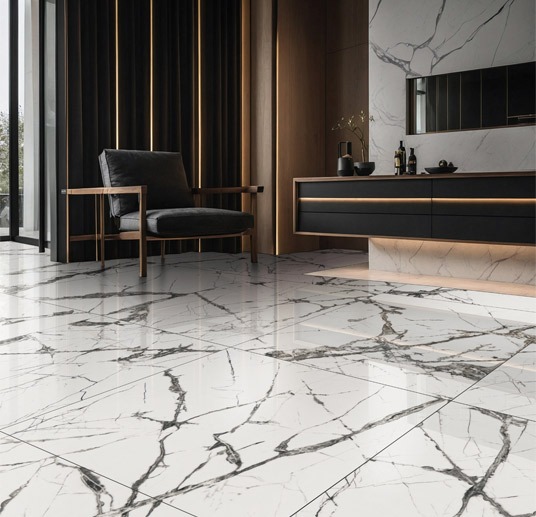
It’s especially effective with stone- or marble-look tile. Instead of seeing a beautiful vein or pattern repeatedly interrupted by grout, larger pieces allow more of the visual to flow across the surface.
Large tile also works with a wide range of interior design styles. A polished marble-look tile can feel elegant, while a large matte concrete-look tile can create an understated modern space. Warm stone visuals can work beautifully in transitional and organic-inspired interiors.
It may seem counterintuitive to put a large tile in a small bathroom or other compact space, but large-format tile can actually help make a room feel more open.
The reason is simple: fewer grout lines create less visual interruption.
A floor covered in many small tiles creates a lot of lines for your eye to process. Larger tiles can produce a more continuous visual plane.
This doesn’t mean every small room should automatically receive the largest tile available. Room dimensions, tile placement, cuts and layout still matter. But homeowners shouldn’t rule out large tile simply because their bathroom, entryway or other space is small.
Sometimes it’s exactly what makes the room feel less busy.
This is probably the most noticeable benefit.
Fewer tiles mean fewer grout joints, creating a cleaner appearance and putting more emphasis on the tile itself.
It can also mean less grout surface to maintain.
Large tiles allow colors, textures and patterns to extend across a larger area before being interrupted.
This can be especially striking with marble-, stone- and concrete-inspired designs.
Large-format tile isn’t limited to floors.
Depending on the specific product and application, it can be used for:
Using the same tile—or coordinating sizes from the same collection—on multiple surfaces can also create a very cohesive design.
Large-format tile often creates the streamlined look associated with custom bathrooms and upscale interiors.
That doesn’t mean the design has to feel formal. The final look depends heavily on the tile’s color, finish, texture and layout.
Large-format tile has plenty of advantages, but it isn’t necessarily the easiest tile to install.
Large tiles don’t conform easily to an uneven floor or wall.
A small tile can sometimes follow minor variations in a surface more readily. A long, rigid tile spanning that same area may rock or create uneven edges.
That makes proper substrate evaluation and preparation particularly important.
As tile dimensions increase, so do the challenges of moving, cutting and setting each piece.
Oversized tiles and panels may require specialty equipment and installation techniques.
Large tile can create beautiful results, but poor placement can leave awkward narrow pieces around walls, fixtures or transitions.
Before installation begins, the room needs to be considered as a whole.
Where will the tile start? Where will cuts fall? How will the pattern relate to the shower, vanity, doorway or other focal points?
These details can significantly influence the finished appearance.
The larger the tile, the more important the surface underneath becomes.
Floors and walls need to meet the requirements for the tile and installation system being used. Uneven surfaces can contribute to problems such as lippage, where one tile edge sits noticeably higher than the adjacent tile.
This isn’t simply a cosmetic concern. Proper preparation also supports the tile and helps create an installation designed for long-term performance.
The exact preparation required depends on the project. That’s one reason professional evaluation before installation is so valuable.
A beautiful tile can’t compensate for an improperly prepared surface underneath it.
Large-format tile can be an excellent choice for shower walls.
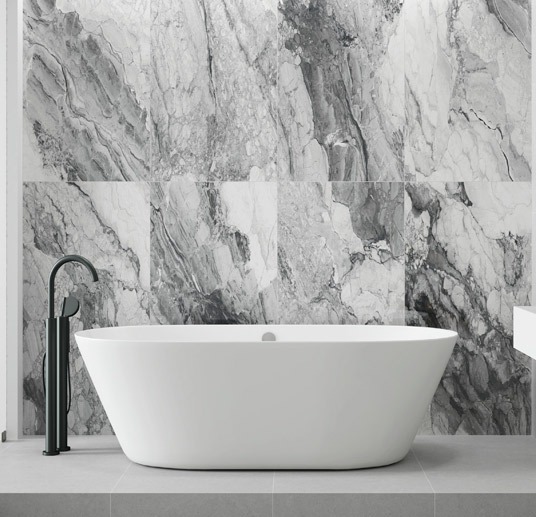
The reduced number of grout lines creates a clean, sophisticated appearance and can allow stone or marble visuals to become the focal point of the shower.
Large tile can also coordinate beautifully with smaller tile used strategically elsewhere—for example, a mosaic on the shower floor or in a niche.
Shower floors require additional consideration because of drainage, slope and slip resistance. Very large tiles may not be appropriate for every shower floor configuration, so product selection and installation design should be evaluated for the specific application.
The goal isn’t simply to use the largest tile possible. It’s to use the right tile in the right location.
Large tile can also work beautifully across larger floor areas.
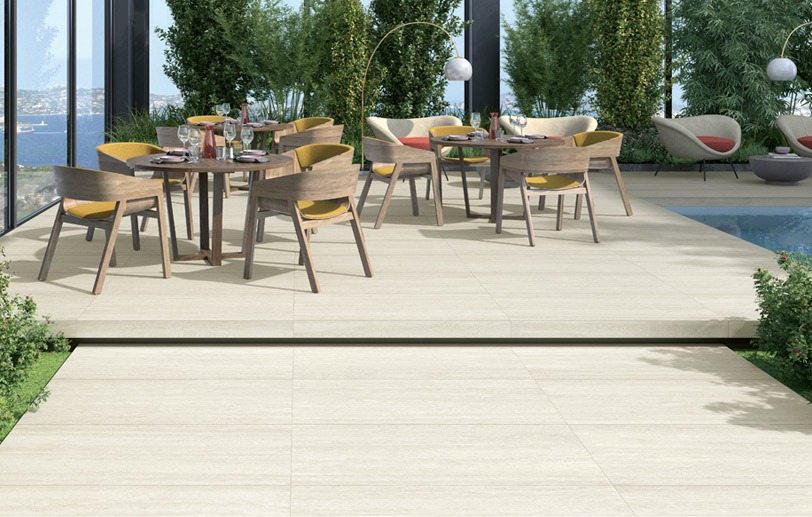
In kitchens, mudrooms and entryways, fewer grout lines can give the floor a streamlined appearance while tile provides the durability homeowners expect in hardworking spaces.
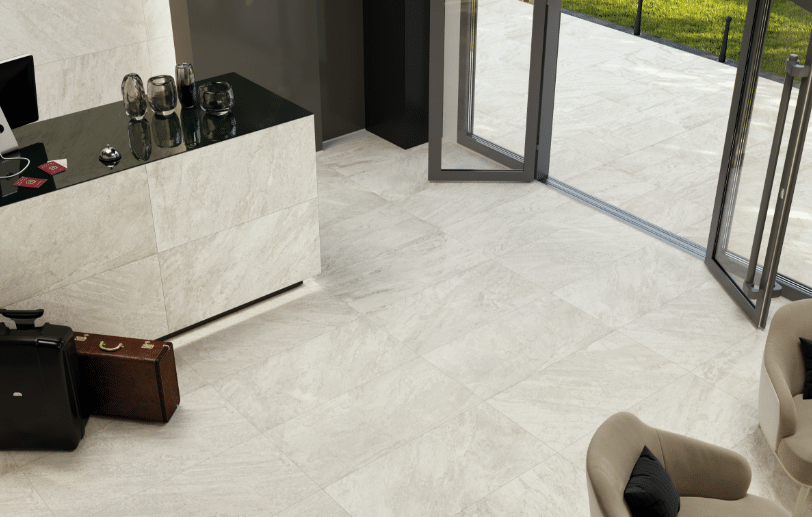
A large stone-look porcelain tile, for example, can provide the visual character of natural stone while offering the performance characteristics of porcelain.
The size of the room should still influence the layout. Sometimes a 12 x 24 tile will be more appropriate than a much larger format. In other spaces, a 24 x 48 tile can make a dramatic statement.
Seeing samples in relation to the actual size of your room can help put those dimensions into perspective.
Large-format tile minimizes grout lines, but that makes the grout you do see important.
Grout color can either blend with the tile or create intentional contrast.
A grout color close to the tile color typically produces a more seamless look. A contrasting grout emphasizes the shape and layout of each tile.
Neither approach is automatically better. It depends on whether you want the eye to notice the tile visual or the tile pattern.
Grout joint size also needs to be appropriate for the tile and installation rather than chosen purely for appearance.
Finish can dramatically change how a large tile looks.
Polished surfaces reflect light and can create an elegant, dramatic appearance. Matte finishes tend to feel softer and more understated while often fitting beautifully into natural, contemporary and transitional designs.
Where the tile is being installed matters as well. Floor applications—particularly areas exposed to moisture—require consideration of the product’s suitability and performance for that location.
A tile that looks beautiful on a showroom display isn’t automatically appropriate for every floor, shower or wall application.
Large-format tile is worth considering if you want:
But choosing tile shouldn’t be based on size alone.
Color, finish, texture, room dimensions, lighting, maintenance, installation conditions and the surrounding finishes all contribute to the final result.
Tile is one of those products that’s difficult to fully appreciate from a small photograph online. Scale, texture, finish and variation can look very different when you see the material in person.
At House2Home Flooring & Design Studio, we can help you compare tile sizes, styles, colors and applications while considering the other finishes in your space.
Bring in photos of your room, cabinet samples, countertop selections, paint colors or even inspiration photos. Looking at the materials together can make it much easier to see what works—and avoid combinations that don’t.
Whether you’re planning a bathroom, shower, kitchen, entryway or another tiled space, we’ll help you find a solution that fits both the look you want and the way the space needs to perform.
Stop into our Ham Lake showroom to explore large-format tile and other tile options for your next project.
H2H – from inspiration to installation.
 https://house2homeflooring.com/wp-content/uploads/2026/11/checker-Feature.png
323
453
Candy Weisenberger
https://house2homeflooring.com/wp-content/uploads/2019/04/House2Home-Logo-Color.png
Candy Weisenberger2026-11-03 12:09:582026-10-12 20:31:25Checkerboard Tile Is Back: A Timeless Pattern with a Modern Twist
 https://house2homeflooring.com/wp-content/uploads/2026/10/motor-Feature.png
323
453
Candy Weisenberger
https://house2homeflooring.com/wp-content/uploads/2019/04/House2Home-Logo-Color.png
Candy Weisenberger2026-10-27 12:42:172026-09-29 17:26:00Motorized Window Shades: Are They Worth It?
 https://house2homeflooring.com/wp-content/uploads/2026/09/Privacy-Feature.png
323
453
Candy Weisenberger
https://house2homeflooring.com/wp-content/uploads/2019/04/House2Home-Logo-Color.png
Candy Weisenberger2026-10-13 15:53:392026-09-29 16:39:35How to Choose Window Treatments for Privacy Without Losing Natural Light

Tues: 8am – 7pm
Mon • Wed • Thurs • Fri: 8am – 6pm
Saturday: 10am – 4pm
Sunday: Closed


 How to Choose Window Treatments for Privacy Without Losing Natural Light